software
Building Halalmegle
What began as a hyperbole amid a discussion theorizing reverse-Salafism later turned into a fun weekend project. Halalmegle is a random video chat where each person is visible only through a slit around the eyes.
The idea started, and mindfully stayed, as a safer Omegle-style random chat. The burqa creates the layer of safety and modesty while still letting people enjoy meeting someone new. In a post-COVID society, that is an important utility: it helps Gen Z rebuild the community and social skills lost during the pandemic by embracing Islamic values.
Modesty is a security property, not just a visual effect. The most important part was keeping people safe from the indecent exposure that plagues Omegle-style sites like Monkey. The system is built so that only the filtered canvas enters the call. There’s no trust between sender and receiver, so incoming frames are checked on the viewer’s device before they’re drawn. The server never sees the raw media either: it only pairs people and relays call setup, and the rest is peer to peer.
| Live | halalmegle.com |
| Stack | Vanilla JS, MediaPipe Face Landmarker, Canvas 2D, WebRTC, Node.js (zero dependencies) |
| Hosting | Fly.io single machine, Cloudflare TURN relay, GitHub Actions CI |
| Platform | Web only, phone and desktop browsers |
| Built | October 28–29, 2026, solo |
Architecture
The whole app is three files:
| File | Role |
|---|---|
index.html | The single-page client |
guard.js | The frame checker |
server.js | A ~400-line, dependency-free Node.js server |
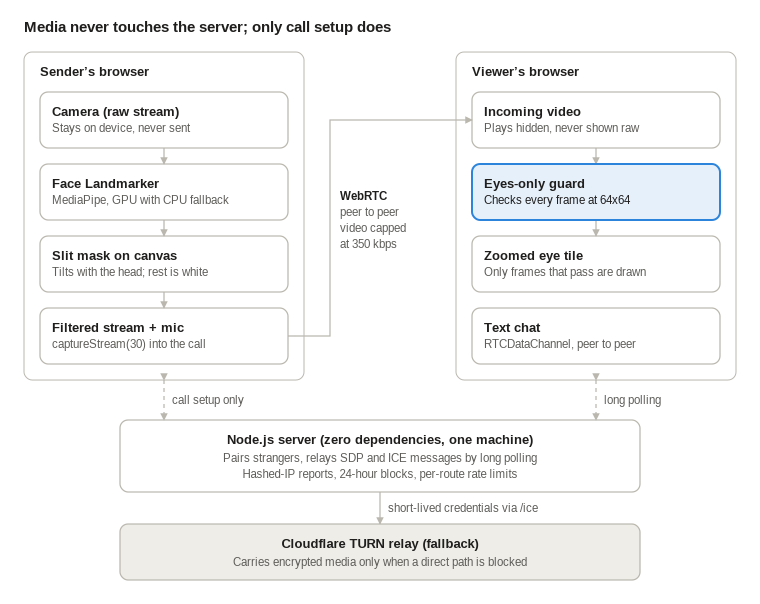
The sender’s browser runs face tracking and paints a white frame with a tilted slit cut around the eyes. Only that canvas stream and the microphone go into the RTCPeerConnection. The viewer’s browser plays the incoming track in a hidden <video>, copies each frame, checks it, and draws it to a visible canvas only if it passes. The server’s job is matchmaking and call setup. Once two browsers are connected, it is out of the media path entirely.
Request flow
| Endpoint | What it does |
|---|---|
POST /connect | Returns an opaque client ID (refused if the hashed IP is blocked or rate-limited) |
POST /poll | Long poll held open up to 25 seconds; delivers queued messages |
POST /join | Enters the matching queue; the matcher pairs the oldest compatible people and picks the WebRTC initiator |
POST /signal | Relays offers, answers and ICE candidates, tagged with a per-call match ID |
POST /report | Files a report against your most recent call |
GET /ice | Short-lived STUN/TURN credentials |
GET /healthz | { ok, online, waiting } for the platform health check |
The per-call match ID on /signal means a late message from a previous call can’t land in the next one.
Decisions
Every major choice came down to two questions:
- Where must this logic run so the guarantee can’t be bypassed?
- What is the cheapest way to run it there?
| Decision | What I chose | Why | What I rejected | Why the rejected path breaks later |
|---|---|---|---|---|
| Where filtering happens | Sender’s device, before encoding | The only point where the raw camera exists; face tracking runs on the user’s own GPU for free | Server-side filtering (media server + ML) | The server receives raw faces, so a breach or legal request violates question one; GPU media servers violate question two |
| Trust model | Viewer re-checks every frame | The receiving browser is the one place a malicious sender can’t reach; the shape check is cheap (64×64) and model-free | Trusting the sender’s filter | The guarantee is only as strong as the least honest user; anyone can open DevTools and send the raw camera |
| Media transport | Peer-to-peer WebRTC, TURN as fallback | Lowest latency, video stays off my infrastructure, bandwidth costs nothing | Always-relayed media | Bandwidth becomes the dominant cost and all media sits on my side of the trust boundary |
| Signaling | HTTP long polling | A few small messages per call; works through every proxy, network and tunnel; zero dependencies; one open poll = one person online on Fly | WebSockets | Adds a dependency and a class of proxy and timeout failures for no user-visible gain |
| Server state | In memory, one instance | One source of truth for who is waiting; blocks rebuilt from the reports log on restart | Redis or a database | Only earns its place with multiple instances, which this traffic doesn’t need |
| Failure mode | Fail to white | An occasional blank second, but no glitch can ever show more than intended | Hold the last mask, or fall back to raw | Leaks exactly when someone moves quickly or a second person steps into view |
The landmark output is checked before a slit is cut: the two eyes must be a plausible distance apart and each eye’s width must fall between 20% and 80% of that distance. Otherwise the frame is blank. The slit is also hard-capped (60% of frame width, 16% of frame height) so a legitimate sender can never produce a frame the receiver’s guard would reject. The sender’s limits and the receiver’s limits were designed as a pair, and a test covers “the largest slit the sender allows, tilted” to keep them in sync.
Landmarks are computed on the exact video frame that gets masked, gated on currentTime changing. Running detection asynchronously on a stale frame would let the mask trail a fast head turn by a frame or two, which is exactly when skin outside the slit would leak.
IPs are stored only as salted SHA-256 hashes, and production refuses to boot without a 32+ character salt or a contact email. Reports keep at most 20 messages of 500 characters each and are pruned after 90 days on startup.
Hard problems
The hardest problem was deciding, on every single frame, whether a compressed video frame from an untrusted peer shows only the burqa filter.
1. A frame checker that survives video compression
The guard can’t run face detection on the incoming stream: a modified client could send a face that a model fails to find. Instead, it checks the shape of what’s not white, which is something the sender can’t fake without also failing the check.
- Copy the frame once into a buffer, so the frame checked is the frame shown (no time-of-check/time-of-use gap).
- Downsample to 64×64 and count “ink” pixels: any channel below 225. The threshold sits well below white, so codec noise and ringing in the white area don’t count.
- Reject if more than 45% of the frame is ink. A raw camera frame fails here.
- Reject if the 90th-percentile column height exceeds 50% of the frame. This catches a tall region that covers little area, such as a face pushed into a narrow strip. Using the 90th percentile instead of the max means a few noisy columns can’t hide a frame.
export const LIMITS = {
  maxFill: 0.45,   // share of the whole frame that may be non-white
  maxColumn: 0.5,  // share of a column's height that may be non-white
};
A rejected frame is never drawn. The “video hidden” note only appears after a block lasts a full second, so someone walking past in the background doesn’t trigger a scary warning. The test suite covers raw frames, tall regions, wide bands, a tilted maximum slit, light noise, and an all-white frame.
2. Keeping the sender’s and receiver’s rules in lockstep
Two independent limits (the sender’s slit cap and the receiver’s guard thresholds) create a classic drift bug: tighten one later and honest users start getting hidden. I treated them as one contract. The sender caps the slit below what the guard accepts, and a test asserts that the largest legal slit, tilted, still passes.
3. Zooming onto eyes the viewer can’t see
Each tile zooms onto the eyes, but the viewer has no landmarks for the stranger. The guard’s inkBounds reuses the same pass to find the bounding box of the non-white area, ignoring rows with fewer than 3 ink pixels and columns with fewer than 2. The zoom box eases 25% toward its target each frame and never zooms past 30% of frame width, so it doesn’t jitter or turn to mush.
4. Connecting on hostile networks
Direct P2P fails on many mobile carriers and school or office networks. The server fetches short-lived Cloudflare TURN credentials (cached for an hour, 5-second timeout, STUN-only fallback on failure). One detail: Cloudflare returns some relay URLs on port 53, which browsers block. Those entries only slowed connection setup, so the server strips them before handing the list to clients.
5. Matchmaking edge cases
| Problem | Fix |
|---|---|
| Stale messages: a late ICE candidate from the previous stranger can corrupt the next connection | Each call gets a fresh match UUID; /signal drops anything whose match ID doesn’t equal the sender’s current call |
| Instant re-matches: with few people online, “Next” would often reconnect the same two people | The matcher refuses to pair the same two within 30 seconds |
| Ghost users: closed tabs and dropped connections | Anyone who stops polling for 40 seconds is removed; the queue is re-matched every 5 seconds |
| Telling a blocked user why | The client is flagged closing and kept just long enough for the “banned” message to reach their open poll, then removed |
Trust, safety and security
Random video chat is a high-abuse category, so I started from a threat model rather than a feature list. Each threat maps to a control that runs where the attacker can’t switch it off.
| Threat | Control | Where it runs |
|---|---|---|
| Unfiltered video from a modified client | The frame guard checks every incoming frame and never draws one that shows more than an eye slit | Viewer’s browser |
| A filter glitch that exposes a face | Fail to white on lost, multiple or implausible faces; capped slit size | Sender’s browser |
| Harassment or explicit behavior | One-tap report (nudity, underage, harassment, spam, other) with the last 20 chat messages attached | Client → server |
| Brigading one user with fake reports | Block only after 3 different reporters in 24 hours; one report per reporter per call; only against your own most recent call | Server |
| Evading a block by waiting for a restart | Blocks rebuilt on boot from the append-only reports log | Server |
| Flooding and scraping | Per-route rate limits per hashed IP; 64 KB body cap; 200-message inbox cap; 5,000-client ceiling | Server |
| XSS, clickjacking and injected third-party scripts | Strict CSP (scripts only from self and jsDelivr, models only from Google storage), frame-ancestors 'none', nosniff, no-referrer, same-origin opener policy, HSTS over HTTPS | Server headers |
| Path traversal on static files | Every path is normalized and must resolve inside public/, or 404 | Server |
| Identifying users from logs | Salted, truncated SHA-256 IP hashes only; no accounts; reports older than 90 days deleted on start | Server |
Outcomes and lessons
Halalmegle went from first commit to a live production site on its own domain over October 28 and 29, 2026. halalmegle.com, HTTPS with auto-renewing certificates, a health check every 30 seconds, and documented runbooks for deploys, secrets and moderation, all shipped.
| Tests | 16 automated tests: 8 for the frame guard, 8 for matching, reports, blocks, rate limits, security headers and the health endpoint |
| CI | Node 22 and 24, plus a Docker build, on every push |
| Infrastructure | One shared-CPU machine with 256 MB of RAM that scales to zero when nobody is online |
| Cost shape | Media is peer to peer, so server cost doesn’t grow with call length |
Put the guarantee where the attacker isn’t. The sender’s filter is a UX feature; the receiver’s guard is the security control. Designing both as one contract is what makes Halalmegle’s promise hold.
Fail closed, visibly. Every uncertain state shows white, and the UI tells the user why (“No face found · they see white”) after a short delay so blinks don’t flash warnings.
Boring infrastructure is a feature. Zero dependencies, long polling and one in-memory instance removed whole classes of problems (supply-chain risk, socket proxies, distributed state) for a product that doesn’t need them.